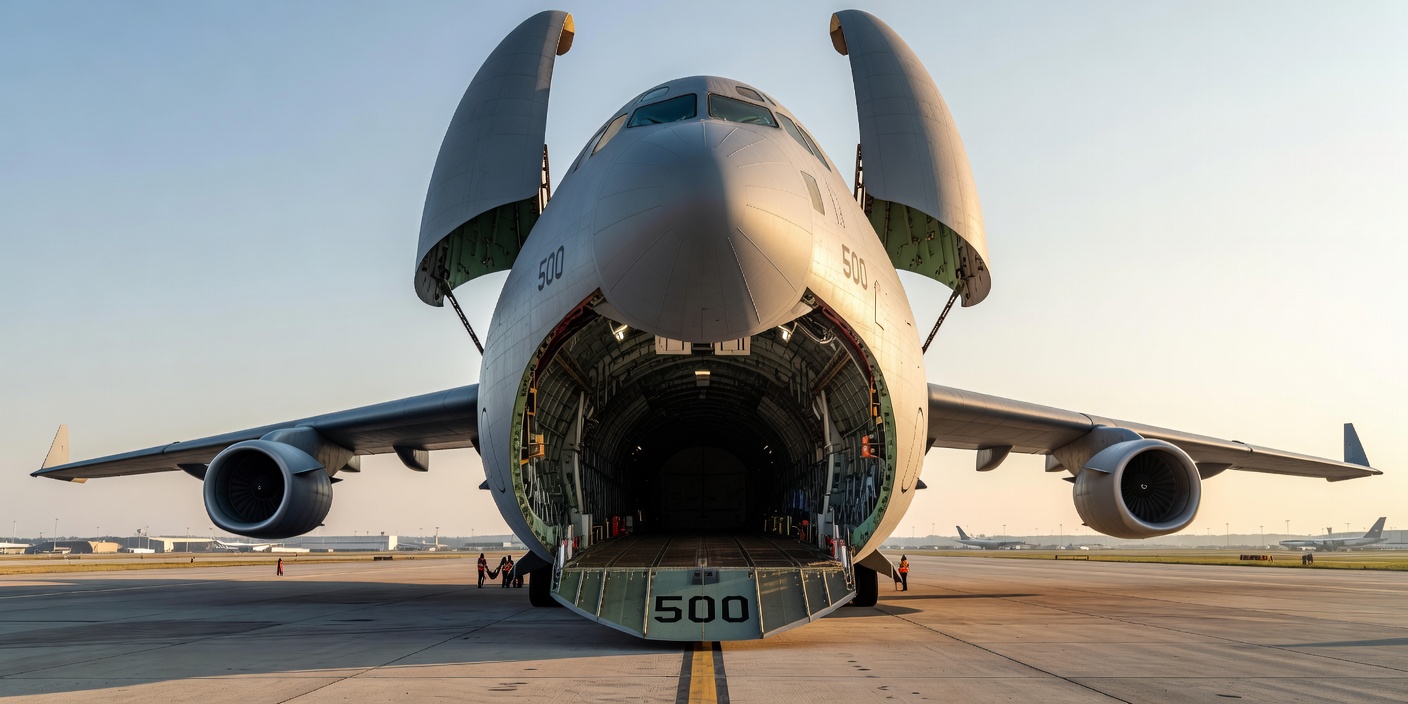
While the Boeing 747 is fondly remembered as a passenger luxury liner, its structural DNA was dictated by freight. Today, long after the twilight of passenger operations for the type, the 747 remains an indispensable titan of the global supply chain, hauling everything from race cars and drilling equipment to consumer electronics.
The Nose Door Advantage
The decision to elevate the flight deck on the 747 was specifically executed to allow for an upward-hinging nose door. This seemingly simple feature was revolutionary. Traditional side cargo doors limit the length of items that can be loaded, as pallets must be maneuvered at a 90-degree angle inside the aircraft.
The 747's nose door permits straight-in loading, utilizing mechanized roller beds built into the floor to ingest exceptionally long or awkwardly shaped cargo—including pipeline sections, helicopter fuselages, and aerospace components. This unique capability continues to give the 747 an edge over competing twin-engine freighters like the Boeing 777F, which rely solely on side-loading operations.
Evolution of the Freighter Variants
Boeing developed dedicated freighter variants alongside passenger models throughout the aircraft's history. The 747-200F brought massive capability enhancements in the 1970s, but it was the 747-400F that truly cemented the aircraft's dominance in the 1990s and 2000s. Featuring modern glass cockpits requiring a two-person crew (eliminating the flight engineer) and boasting a payload capacity of approximately 113 tonnes (249,000 lbs), it became the workhorse for integrators and dedicated cargo airlines alike.
In the 2010s, Boeing introduced the 747-8F. By stretching the fuselage by 5.6 meters and outfitting it with advanced GEnx engines derived from the 787 Dreamliner, Boeing created a freighter that offered 16% more revenue cargo volume than the 400F, while operating with significantly lower fuel burn and noise footprint.
Logistics Giants: Atlas Air and Cargolux
Dedicated cargo operators embraced the 747 heavily. Operators like Luxembourg-based Cargolux (the launch customer for the 747-8F) and New York-based Atlas Air built their business models around the capabilities of the Jumbo. Atlas Air grew to operate the largest fleet of 747 freighters in the world, flying scheduled networks and complex charter operations globally on behalf of integrators like DHL and Amazon Air.
Even converted passenger airframes—referred to as Boeing Converted Freighters (BCF) or Special Freighters (BDSF)—found decades of renewed life. While these lacked the iconic nose door, their main deck capacity provided economical heavy-lift capabilities for carriers expanding their logistics footprints in developing markets.
Enduring Relevance
As the world observed the COVID-19 pandemic, global supply chains strained and passenger belly-cargo capacity evaporated overnight. During this crisis, the global fleet of 747 freighters proved absolutely vital, operating relentlessly to distribute medical supplies, vaccines, and consumer goods. Despite its four engines and older foundational design, the 747 Freighter's unmatched volumetric capabilities ensure it will remain an active and essential fixture at cargo hubs worldwide for decades to come.