In the mid-1960s, commercial aviation was experiencing unprecedented growth. The introduction of the Boeing 707 and Douglas DC-8 had made jet travel a reality for the masses, but airports were rapidly becoming congested. It was in this environment that an ambitious airline executive and a brilliant engineering team set out to build an aircraft that defied the conventional limits of scale.
The Vision of Juan Trippe
The story of the Boeing 747 begins not in Seattle, but in the boardrooms of Pan American World Airways. Juan Trippe, the legendary president of Pan Am, recognized that passenger demand was outstripping the capacity of his existing fleet of 707s. He envisioned an aircraft two and a half times larger than anything currently flying—a machine that could lower the cost per seat mile and truly democratize international travel.
Trippe famously approached Boeing president Bill Allen with a challenge: if Boeing built it, Pan Am would buy it. Allen's response cemented the partnership: if Pan Am bought it, Boeing would build it. In April 1966, Pan Am placed a landmark $525 million order for 25 aircraft. This was an astonishing sum, representing a massive financial risk for both companies. Had the 747 failed, it is widely believed that it would have bankrupted the Boeing company.
Joe Sutter and the "Incredibles"
Tasked with leading this monumental engineering effort was Joe Sutter, a pragmatist and aerodynamicist who would soon become known as the "Father of the 747." Sutter assembled a team of roughly 4,500 engineers. Working at a breakneck pace, this team—affectionately dubbed "The Incredibles"—faced immense technical challenges.
One of the primary issues was structural weight. Early concepts proposed a double-deck "double-bubble" fuselage, similar to stacking two 707 fuselages on top of one another. Sutter's team realized this design hindered passenger evacuation and cargo loading. The decision was made to widen the main fuselage instead, creating the first twin-aisle wide-body interior. The cockpit was placed above the main deck to allow for a hinged nose door for cargo, inadvertently creating the 747's iconic upper deck hump.
Building the Factory to Build the Plane
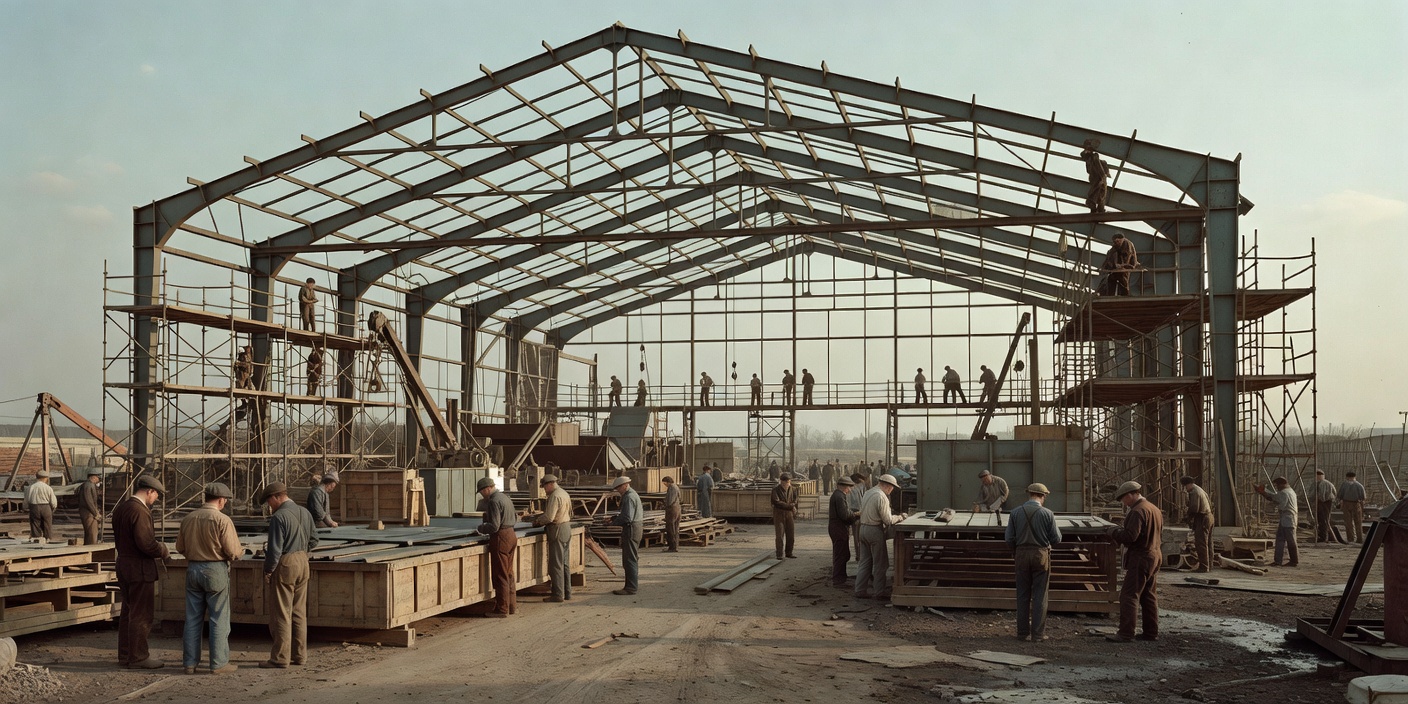
Boeing did not possess a facility large enough to construct the 747. Consequently, they purchased a 780-acre site adjacent to Paine Field in Everett, Washington. The resulting assembly plant is still recognized by volume as the largest building in the world.
The timeline was punishing. From the initial design phase to the rollout of the first prototype (the "City of Everett"), Sutter's team had only 29 months. It was a period marked by grueling overtime, frantic redesigns to shed excess airframe weight, and continuous struggles with the newly developed Pratt & Whitney JT9D high-bypass turbofan engines, which frequently experienced compressor stalls during early testing.
First Flight and Entry into Service
On February 9, 1969, the 747 took to the skies for the first time with test pilots Jack Waddell and Brien Wygle at the controls, alongside flight engineer Jess Wallick. Despite minor issues with the trailing edge flaps, the aircraft proved to possess excellent handling characteristics, dispelling fears that a plane of its massive size would be sluggish or difficult to fly.
Following a rigorous flight test program, the Boeing 747 entered commercial service on January 22, 1970, on Pan Am's route from New York's John F. Kennedy International Airport to London Heathrow. The sheer scale of the aircraft completely altered the passenger experience, introducing lounges, spiral staircases, and twin-aisle seating. The era of the Jumbo Jet had officially begun, setting a standard for long-haul travel that would endure for over half a century.