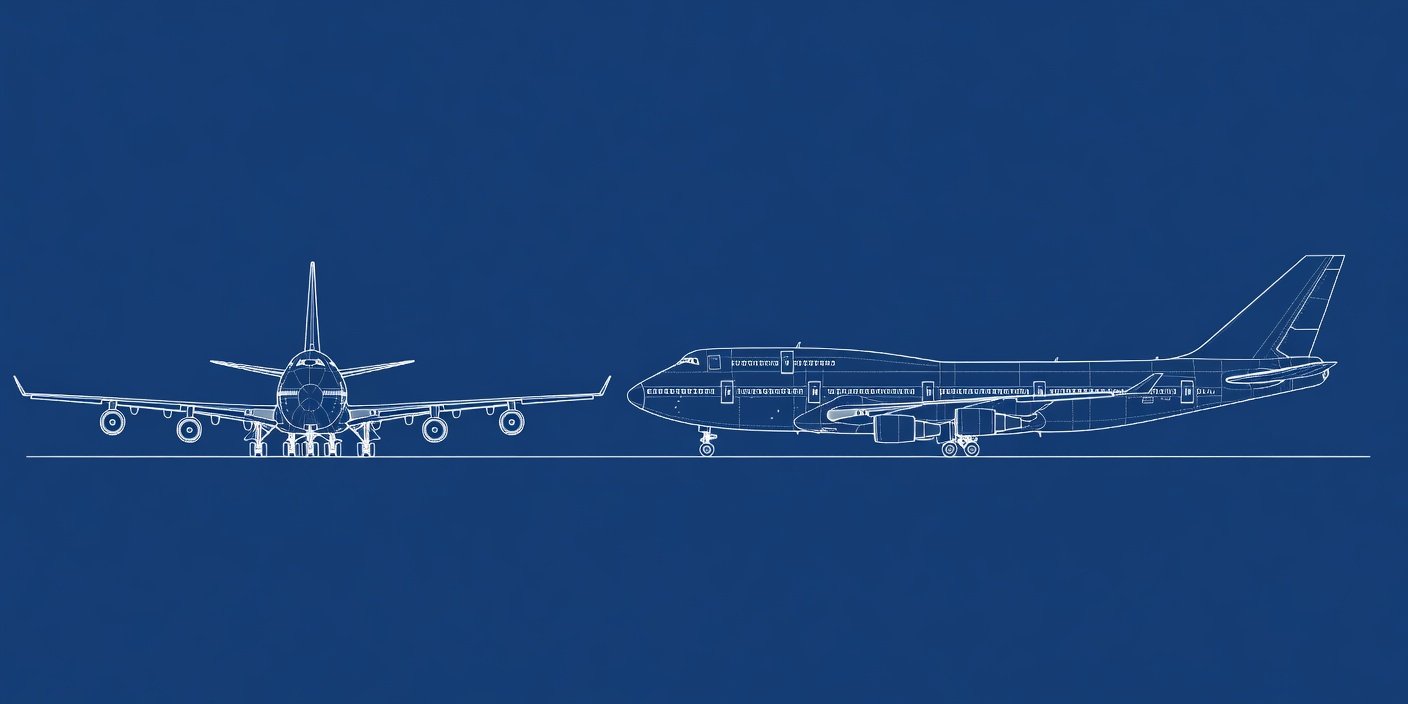
The Boeing 747 was an aircraft built out of necessity, yet its design proved to be an aerodynamic masterpiece that established paradigms used in commercial aircraft for decades to follow. From its swept wings to its massive landing gear array, the engineering behind the 747 represents a watershed moment in industrial design.
The Reason for the Hump
Perhaps the most distinctive visual feature of the 747 is its upper-deck "hump." In the 1960s, supersonic transport (SST) aircraft were widely expected to render subsonic passenger jets obsolete. To ensure the 747 would have a viable secondary market as a freighter when SSTs took over, Boeing designed the fuselage to accommodate standard 8-by-8-foot shipping containers.
Loading these containers efficiently required a nose-loading door. Consequently, Joe Sutter's team moved the cockpit up and out of the way, placing it above the main deck. The aerodynamic fairing required to smooth out this raised cockpit extended backward, creating a small upper deck originally intended for crew rest, but eventually utilized as an exclusive passenger lounge. Over subsequent variants, such as the 747-300 and 747-400, this hump was elongated to hold more passengers, further improving the aircraft's aerodynamic profile according to the area rule.
Aerodynamics: The Swept Wing
To achieve the desired cruising speed of Mach 0.85, the 747 required highly swept wings. Boeing engineers settled on a sweep angle of 37.5 degrees, notably steeper than the 707. This sharp angle mitigated the effects of compressibility drag at high subsonic speeds but introduced a new problem: high approach speeds and reduced low-speed lift.
To compensate, the wing was equipped with a complex array of high-lift devices. The leading edges feature Kruger flaps inboard and variable-camber slats outboard. The trailing edges utilize immense triple-slotted flaps. When fully deployed for landing, these flaps increase the wing area by 21% and increase lift by 90%, allowing the massive aircraft to approach the runway at safe, conventional speeds.
High-Bypass Turbofan Engines
The 747 would not have been possible without parallel advancements in propulsion. Earlier jets utilized low-bypass turbojets, which were excessively loud and fuel-hungry. The 747 required immense thrust, leading to the development of the Pratt & Whitney JT9D—one of the first high-bypass turbofans designed for commercial use.
By passing a significant portion of the incoming air around the engine core rather than through it, the JT9D offered dramatically increased thrust, lower fuel burn, and a substantial reduction in noise. While early iterations suffered from "engine surge" and casing distortion problems—leading to a famous backlog of engineless 747 airframes sitting on the tarmac at Everett—subsequent refinement turned the high-bypass turbofan into the undisputed standard for all modern commercial airliners.
Landing Gear Redundancy
Distributing a maximum takeoff weight (MTOW) that exceeded 700,000 pounds required a robust undercarriage. The 747 employs a complex system of 18 wheels: two on the nose gear and four bogeys of four wheels each under the main fuselage and wings.
This distribution ensures that the aircraft's footprint pressure on taxiways and runways remains within limits acceptable to airports built for much smaller aircraft. Furthermore, the design provides immense redundancy. The 747 is technically capable of landing safely even if two of its four main gear bogeys fail to deploy, highlighting the rigorous safety margins engineered into the airframe.